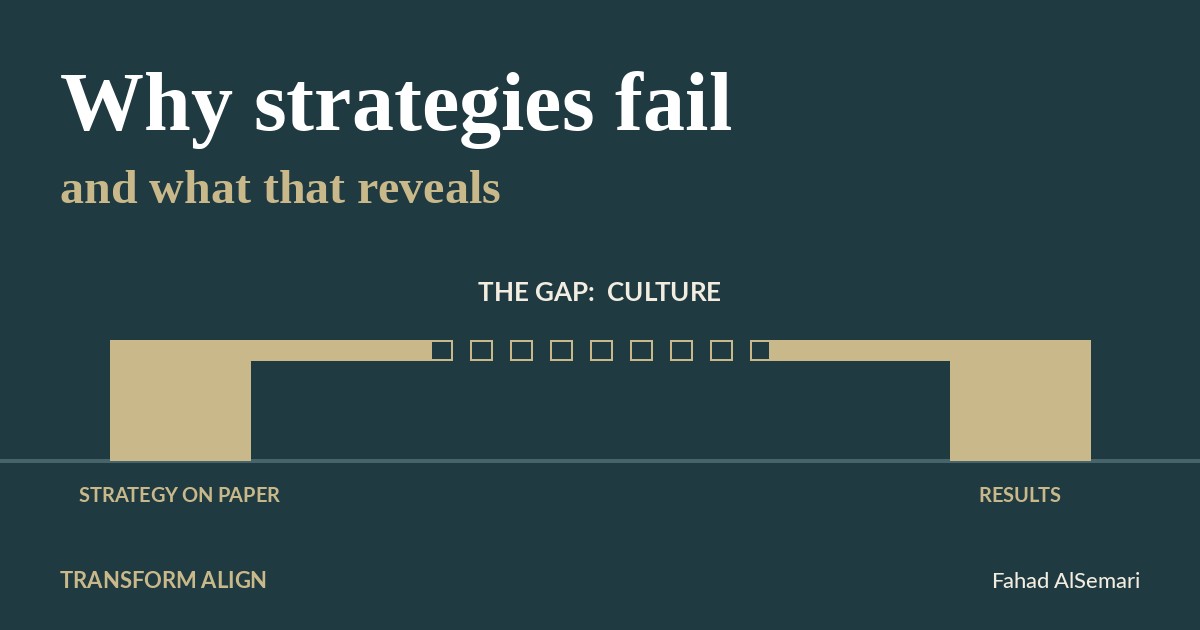
Most strategies do not fail on paper. They fail in the gap between what leaders intend and what the organization actually does.
Strategy frameworks have never been more plentiful, yet most strategies still fail. Surveys put the share that fail in execution at about two thirds, and McKinsey has found that only around 30% of corporate transformations succeed. The ideas are rarely the problem. The systems that must carry them out are.
That is why a useful strategy begins not with a vision statement, but with a diagnosis of how strategies break.
Four places where strategies break
Culture and communication. The strategy asks for behaviors that the culture resists. It is announced once rather than cascaded and repeated, so most people never understand it. Over time it becomes a ritual: the plan is presented, applauded and filed.
Leadership and ownership. Leaders approve the strategy but do not model or reinforce it. Outcomes have no named owner, so they quietly disappear, and each function pursues its own part until the whole fractures.
System design. The strategy assumes capabilities the organization does not have. It is not backed by a budget, so it remains a wish list, and it is not linked to KPIs and incentives, so people are not rewarded for carrying it out.
Focus and adaptability. Too many disconnected priorities and too many projects overwhelm execution, while a strategy that never adapts becomes irrelevant in a changing market.
What this reveals
Most of these failures are symptoms, not causes. Behind them sits culture. Over time every organization builds unwritten rules about what is safe, what is rewarded and what is punished. Those rules govern managers and workers alike, and they resist change.
Take communication. In many organizations top management holds confidentiality as a strong value. The strategy is therefore kept as a closely guarded secret, and in many cases some senior managers never see it. No one decided that communication should fail; the unwritten rule produced the failure on its own. The same applies to accountability, where blame is safer than ownership, and to leadership engagement, where approving a plan is rewarded and living it is not.
This is why fixing them one at a time rarely lasts. A new communication plan, a new scorecard or a new initiative office will be absorbed by the same rules that produced the problem. Unless the culture is addressed, most of these factors will remain.
Three questions before the next strategy
- Who in the top team has not seen the strategy, and why?
- Which behavior does the strategy require that our culture currently discourages?
- Who owns each outcome by name, and is it in that person's scorecard and budget?
If the answers are uncomfortable, that is useful. They show where the strategy will break, and the break can then be repaired before it costs anything.
Figures: the McKinsey estimate of roughly 30% of transformations succeeding is from its transformation surveys; the roughly two-thirds failure rate is from strategy-implementation surveys by Bridges Business Consultancy and others.
Stay updated
Register to be kept informed of new articles, training and speaking events.